Sunday, 26 May 2013

Meditation from the Doge's Palace, Venice.


I walk slowly through this crumbling beauty
In quiet, still, crowd-free early morning,
Passing by the little pontes, the Rialto Bridge,
Sleek, curved, black gondolas at their mooring;
I wander narrow lanes and alleyways
To St. Marks’ Square, its splendour of marble,
Into the Doge’s Palace, the Golden Staircase,
And there in awed silence stop and marvel.

Rich, carved and painted rooms reveal a past
When trade from the East made Venice great;
Unimaginable wealth and great beauty
Designed to overwhelm and intimidate.
In this room nervous ambassadors waited;
This one has a Raphael painted ceiling;
A third and fourth are to judge and govern;
A fifth has paintings deeply revealing.

This fifth is large.  Paintings floor to ceiling
Depict Venetian sea battles. On each wall
Thousands of ships tangle in brutal chaos,
Scenes of death and horror which deeply appal.
In the forefront of one a man in agony,
Eyes rolling, mouth open, clutches an arrow
Embedded in the centre of his forehead,
A single emblem of this carnage and woe.

 I walk back into beautiful St Mark’s Square.
It too has displays of wealth and power-
Gilded mosaics, golden winged angels,
The spear-wielding saint on his high tower.
My mind is troubled by those sea battles,
The thought of that sailor as he dies,
Troubled too by the thought that this splendour
Came at the cost of ordinary men’s lives.

Then I think of that old paradox-
How rapacious commerce plays its part
Not just in the beauty of architecture
But in the wonder and glory of art,
And looking around this beautiful place,
This land ingeniously reclaimed from the sea,
See in it the beauty and the horror
That characterises human society.

And walking slowly past the gypsy beggars,
The street hawkers, the tangled human throng
That moves in shoulder to shoulder press,
Everywhere I hear that ancient song
Of money, power, desire and need,
That relentless pursuit of beauty and wealth,
Save Venice no longer needs ships to trade,
For Venice has trade sufficient in just itself.

A little ponte.


The Rialto Bridge.


The narrow lanes...


Sleek, curved, black gondolas.


Doge's Palace


Courtyard, Doge's Palace


Golden Staircase


Gilded Mosaics, St. Mark's.


Gilded Mosaics.


Statues, St. Mark's.


Home, Hotel Al Vagon.


Thursday, 16 May 2013

Come.


Come. It is the dawn. We must move on.
Autumn’s blue stillness is in the air.
Summer’s shimmering heat has gone.
The day that rises is calm and fair.

Think not on what lies behind or ahead.
Press on in courage, faith and belief.
Each day’s journey is sufficient to itself;
Each day will contain both joy and grief.    

Night is coming when travel ceases,
Winter will bring its own bitter states;
But beyond the night and winter’s chill
On high mountain slope the summit awaits.

We have our map. We have our hope.
The journey’s end is within our reach.
What if the way is fierce, hard and wild?
Waiting at the summit is joy and peace.

As long as you travel by my side
Of each day’s trials what do I care?
Even the burdens in the blue-black clouds
In hindsight can seem as light as air.

So let us be gone. Let us travel together
Through each day’s jubilation and sorrow.
Hand in hand we will support each other.                              
Resolutely we will face the morrow.
                       

Saturday, 11 May 2013

Repentance


Repentance is pride’s bane,
The soul’s renewal or birth,
The releasing of those chains
That bind us strongly to the earth.
Then freed from the folly of pride
And all angst-filled mortality,
On eagle’s wings the spirit soars
Towards the summit of eternity.

Saturday, 27 April 2013

Postcard fom Sienna. Carravaggio's "St. John the Baptist."

After the relentless repetition
Of Annunciation, Nativity and Crucifixion;
After the sadistic scenes of Last Judgment
With their florid, cruel sensuality,
Their crowded, muscular nakedness;
After the ornate splendour of palaces
Covered from wall to ceiling in  paintings
Abundant in blue, gold and red,
Depictions of battle, death and victory
Or violent, Biblical narrative;
After the Duomos' marbled ostentation,
Their great domes, sculptures and dark themes-
After these things you walk down a darkened crypt,
Past fading depictions of gospel scenes,
Your mind numb from days of surfeit
And there it is, Carravaggio's "St. John the Baptist",
Not the prophet from the Judaean wilderness
With his fiery, uncompromising words
But a slender boy, or perhaps a youth,
Rendered in exquisite truthfulness.
His skin is luminously beautiful.
The light, from the left, touches him
On cheekbone, shoulder, thigh, knee, calf.
The lines, composition and colour are masterful
But its transcending wonder is in its truthfulness.
The youth turns from his simple herder's task
As if you've suddenly surprised him,
Not in anxiety but in a complex mixture
Of amusement, confidence and shyness,
A friendly, joyous gaze
As if the nuance of his mind
In this single, fleeting moment
Has been caught in Carravaggio's brush
And effortlessly placed upon the canvas
So we, who come to it after so many centuries,
Can be transfixed by its beauty and truth,
And feel thankful for the privileged glimpse
Into the momentary mind of that boy
And the transcendent power that captured it.


Monday, 22 April 2013

Postcard from Florence. The Duomo.


You come upon it suddenly,
Meandering through the narrow streets,
Past the beige, time-coated buildings,
Turning down the curve of Via de Martelli,
Casually drawing near to the street's end
And then you gasp.

You come upon it unprepared,
Seeing at first only the soaring facade
And the enormity of its tower,
But turning into Piazzo Duomo
You see its length, the immensity of its domes,
And again you gasp.

You come upon it in amazement,
Seeing it as entirely marble, glistening white
With geometric patterns in pink and green,
Embroidered, scrolled, balanced, harmonious,
Exquisite in scope and detail,
And you must admire.

You come to it in awe.
The front is a composition in threes.
Three great doors rise in elegant curves.
Above them are three circles spoked like sunbeams.
Always the one in the centre is highest or largest
And you think you understand.

You come to its details.
There are complex, embroidered patterns in stone,
Colourful paintings above each door, surely in stone,
Lines of sculptured figures in porticoes of blue
And circular inlays glinting with gold
And you feel overwhelmed.

Perhaps later you will walk through the doors
And again feel its power and artistry,
Or you will climb the narrow stairwell
To the dome's dizzying height and power.
Perhaps you may, at some later date, question
To whose glory this buiding was made,
But now, in this first sudden moment
You are overcome by its beauty
And, dimly realising its complex grandeur,
Praise the vision that conceived it,
The capabilities that built it,
The artistry that embellished it,
The materials that adorn it
And you stop, stand still, and stare.


Front with part of the tower.


Window detail.


Front door detail


Partial view of dome from baptistry.


Detail above side door


Wednesday, 17 April 2013

Postcard from Cinque Terre. Riomaggiore.

The bells toll all night on the hour and half hour.
The stream, piped under the main street,
Makes its noisy exit into the sea
But little Riomaggiore sleeps on.
The green shutters are closed. All is quiet
In the multi-coloured, bright buildings
Rising steeply up the V-shaped valley
Through narrow alleys, steps and little squares
To the two churches, their bells and, finally, the fort.

All is quiet too in the sinuous lines
Of ancient, dry-stone walled terraces,
Beautiful in the purest, most simple way,
Stepping the steeply rising terrain
From cliff's edge to high mountain ridge,
The labour of scores of thousands
Of men and women over centuries.
With what effort they were built, filled with vines,
Olives, a scattering of figs and lemons
And left as a legacy to the grateful future.

At 7 A.M. both church bells toll
Over forty times in strange syncopation
And little Riomaggiore arises:
Coffee is served in Bar Centrale;
Workers gather, sit, talk and smoke;
Garbage is collected; produce delivered;
Shopkeepers are arranging boxes of fruit
On either side of their front door.
The Take-Away Pizzerias, the restaurants,
The "Authentic Italian Pasta" shop,
And Gelataria Centrale sleep on,
As do the gift shops, the laundromat,
And "Art in Banchi", with its exquisite pottery and craft.
Soon, they too will open and little groups
Will stand noisily and happily chatting
And flocks of tourists will emerge
From the pink, blue, yellow and ochre buildings
With backpacks, cameras and poles
To walk the beautiful, steep, terraced hills
And medieval villages of the Cinque Terre.


Riomaggiore.


The stream exiting into the sea.


Monday, 15 April 2013

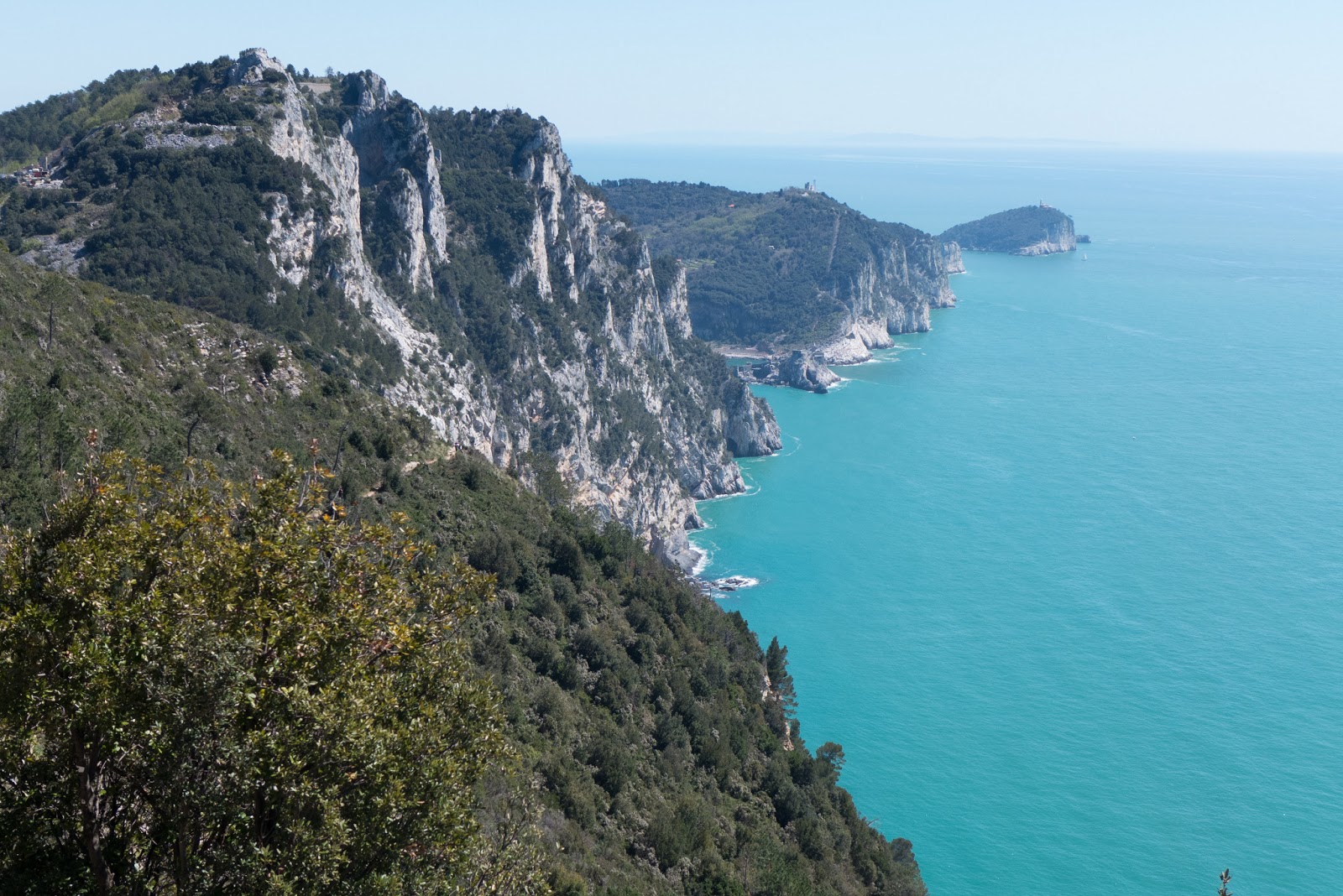
Postcard from Riomaggiore. A Walk to Porto Venere.


From Riomaggiore the almost vertical track
Rises step after step up through the terraces.
At resting points there are superb views
Along the steep and rugged coastline
And glimpses of the brightly coloured
Ancient villages of the Cinque Terre.
Then, at over three hundred metres,
We begin to walk along the terraces,
Still climbing, but less steeply,
Up the west sloping mountain-side.
Suddenly, we are on a narrow ridge.
The lightly wooded land drops quickly away.
To the left, way below in the far distance,
La Spezia clings to a beautiful bay
And beyond that, on the horizon,
Are the marble, snow-covered Alps.
To the right, through the light woodland,
Is the glittering blue of the sea,
At some indistinct point
Merging with the blue of the sky.
The day is mild and still. A single bird sings.
Our footsteps are muted on the pine-needled path.
In dappled shade, we walk in hushed quiet
And silently gaze in awe and wonder.


Riomaggiore

The Cinque Terre coastline with Monterossa in the far distance


On the lightly wooded ridge line


The view to the left.


On the right...


Porto Venere, journey's end, 14 kms and a lot of climbing.